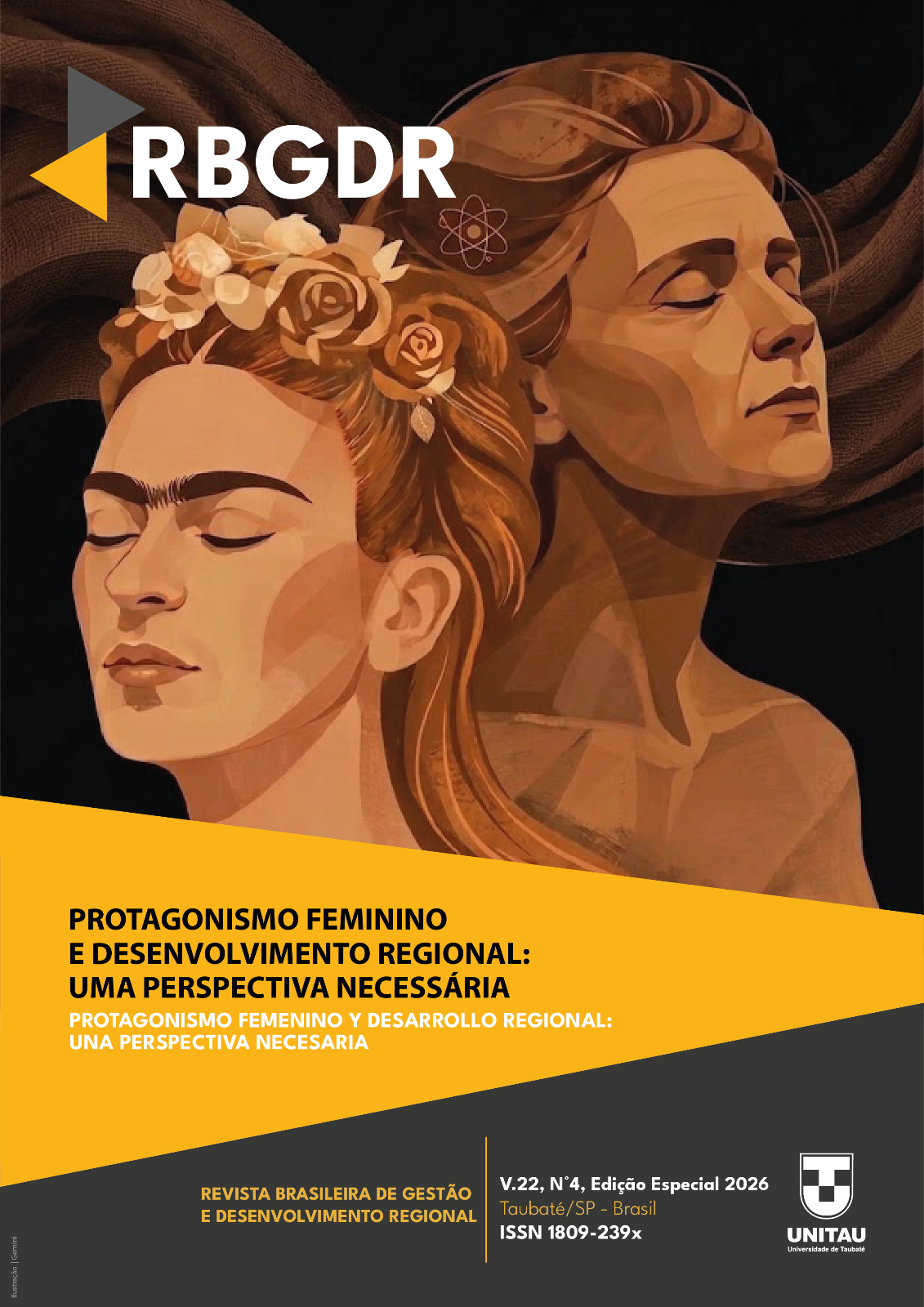
FEMALE LEADERSHIP AND TERRITORIAL PUBLIC POLICIES: AN ANALYSIS OF THE TERRITORIES FOR PEACE PROGRAM (TERPAZ)

Authors

DOI:

https://doi.org/10.54399/rbgdr.v22i4.8545

Keywords:

Public Policies; Territory; Female Protagonism; Citizen Security; Territorial Development.

Abstract

This article analyzes female protagonism within the framework of the Territories for Peace Program (TerPaz), an integrated territorial public policy implemented in the State of Pará aimed at promoting citizen security and reducing social inequalities in territories marked by high levels of vulnerability. The objective of the study was to understand how women’s actions contribute to territorial development, the strengthening of social protection networks, and the effectiveness of public policies. Methodologically, a qualitative approach was adopted, supported by bibliographic and documentary research, including the analysis of institutional documents, technical reports, and service delivery data from the Usinas da Paz (UsiPaz). The study was grounded in conceptual theoretical frameworks on territory, public policies, regional development, and gender. The results show that women occupy a central position both as beneficiaries and as agents of implementation and mediation of the program’s actions, becoming responsible for mobilizing community networks, expanding access to public services, and strengthening social capital within the territories. It is concluded that female protagonism constitutes a structuring element of citizen security and territorial development, enhancing the impacts of TerPaz and highlighting the need to incorporate a gender perspective transversally into the planning and management of territorial public policies.

Downloads
Download data is not yet available.

Author Biographies

Marisa Elenice Silva Lima, UNAMA

PhD candidate in Administration at the University of the Amazon (UNAMA). Master’s degree in Social Work from the Federal University of Pará (2010). Specialization in the Design and Management of Social Projects from the Brazilian Technological Educational Center (2016). Holds a Bachelor’s degree in Social Work from the Federal University of Pará (2006). Served as a professor in postgraduate programs at UNAMA (2015) and at Galileo Cursos (affiliated with Estácio de Sá) in 2012 and 2016. Worked as a tutor at Faculdade Anhanguera (2012–2015), Coordinator of the Social Work program at UNINASSAU, Coordinator of the Territories for Peace Program in the Cabanagem district (2019–2020), Secretary of Citizenship, Social Assistance and Labor in the municipality of Ananindeua (2021–2023), and Director of the Brazilian Women’s House in Ananindeua (2023–2024). Currently serves as a Professor in the Social Work program at UNAMA and as Director of Economic Autonomy and Cross-Cutting Policies at the State Secretariat for Women. Has experience in the field of Social Work, with an emphasis on labor, social assistance, teaching, housing, social policies, the design of social projects, and social project management.

Fabia Jaqueline Miranda Nobre, Universidade da Amazônia

Bachelor’s degree in Social Work from the Federal University of Pará (2005). PhD in Administration from the University of the Amazon (2022). Master’s degree in Social Work from the Federal University of Pará (2009). Specialization in Social Policy Management from the University of the Amazon (2008). Executive MBA in Higher Education Institutional Management from the University of the Amazon (2021). Currently a tenured professor in the Stricto Sensu Graduate Program at UNAMA – Professional Master’s Degree in Knowledge Management for Socio-Environmental Development, and a professor in the undergraduate program in Public Management Technology and the specialization program in Legislative Public Management at the Foundation School of the Legislative Power of the Legislative Assembly of the State of Pará. Member of the Research Group on Amazonian Social and Regional Development, in the research line Social Work and Amazonian Social Development. Member of the Evaluation and Analysis Committee for Administrative Processes related to Diploma Recognition – National Diploma Recognition System – Carolina Bori Platform.

Ana Maria de Albuquerque Vasaconcellos, Universidade da Amazônia

PhD in Development Studies – University of Wales Swansea (2008). Doctoral degree validated by the Center for Advanced Amazonian Studies (NAEA) of the Federal University of Pará (2008). Specialization in Higher Education Teaching (1993). Master’s degree in Sustainable Development of the Humid Tropics from the Federal University of Pará (1996). Bachelor’s degree in Social Sciences from the University of the Amazon (1986). Permanent professor in the Graduate Program in Administration (PPAD) since 2009, having been its first coordinator when the program offered only the master’s degree. Permanent professor in the Graduate Program in Urban Development and Environment (PPDMU). Currently Pro-Rector for Graduate Studies at the University of the Amazon since 2014. Member of the Social Management Network (RGS) and Ad Hoc Consultant for CAPES. Member of the Editorial Board of the journal Amazônia: Organizations and Sustainability. Reviewer for the following journals: Cadernos Gestão Social (CGS), Cadernos EBAPE, Revista Amazônia, Organizações e Sustentabilidade, Revista Interações, and RAP. Research and teaching activities focus on social management, local development, social governance, and public management.

Maria Betânia de Carvalho Fidalgo Arroyo, Universidade da Amazônia

PhD in Administration from the Graduate Program in Administration (PPAD) at the University of the Amazon (UNAMA), 2020. Master’s degree in Higher Education Teaching and University Management from the University of the Amazon (UNAMA), 1998. Currently serves as Rector of the University of the Amazon (UNAMA). Re-elected President of the State Council of Education (CEE) of the State of Pará. Member of the Municipal Council of Education (CME) of Belém, representing the Union of Private Educational Institutions (SINEPE). President of the Board of Trustees of the Foundation Institute for the Development of the Amazon (FIDESA). President of the Rectors’ School of the State of Pará (FIESPA). Director of the Legislative School of the Legislative Assembly of the State of Pará (ALEPA). Regional Director of the Ser Educacional Group. Member of the Pará Academy of Letters (APL). Academic Advisor/Professor at MUST University. Permanent faculty member of the Stricto Sensu Graduate Program in Communication, Languages, and Culture (PPGCLC) at UNAMA. Researcher and Coordinator of the Gender Relations research line of the GEPIDIi research group at UNAMA. Researcher in the Research Group on Innovation and Organizational Management (GPIGO/UNAMA). Has experience in the field of Education, with emphasis on Higher Education, working mainly on the following topics: School Management, Knowledge Construction, Teacher Education, and Women’s Studies.

Cacilene Moura Tavares, Universidade da Amazônia

PhD in Science and Mathematics Education – PPGECM/UFPA (2023). Master’s degree in Science and Mathematics Education – PPGECM/UFPA (2016). Specialist in Psychomotricity – UEPA (2001). Bachelor’s degree in Pedagogy – UEPA (2000). Full Professor in the Stricto Sensu Graduate Program in Knowledge Management for Socio-Environmental Development (PPGC) at the University of the Amazon. Professor in the Pedagogy undergraduate program at the University of the Amazon (UNAMA). Vice-leader and Researcher of the Study and Research Group on Diversity and Inclusion (GEPIDI/UNAMA). Member of the Study Group on Science, Technology, and Society (GECTSA) at the Federal University of Pará (UFPA). Chair of the Structuring Teaching Nucleus (NDE) and of the Pedagogy Course Council at UNAMA. ORCID: https://orcid.org/0000-0002-6301-9011

Published

2026-11-04

How to Cite

Silva Lima, M. E., Miranda Nobre, F. J., de Albuquerque Vasaconcellos, A. M., de Carvalho Fidalgo Arroyo, M. B., & Moura Tavares, C. (2026). FEMALE LEADERSHIP AND TERRITORIAL PUBLIC POLICIES: AN ANALYSIS OF THE TERRITORIES FOR PEACE PROGRAM (TERPAZ). Revista Brasileira De Gestão E Desenvolvimento Regional, 22(4). https://doi.org/10.54399/rbgdr.v22i4.8545

Issue

Section

Dossiê - Protagonismo Feminino, Ciência e Desenvolvimento Regional na América Latina