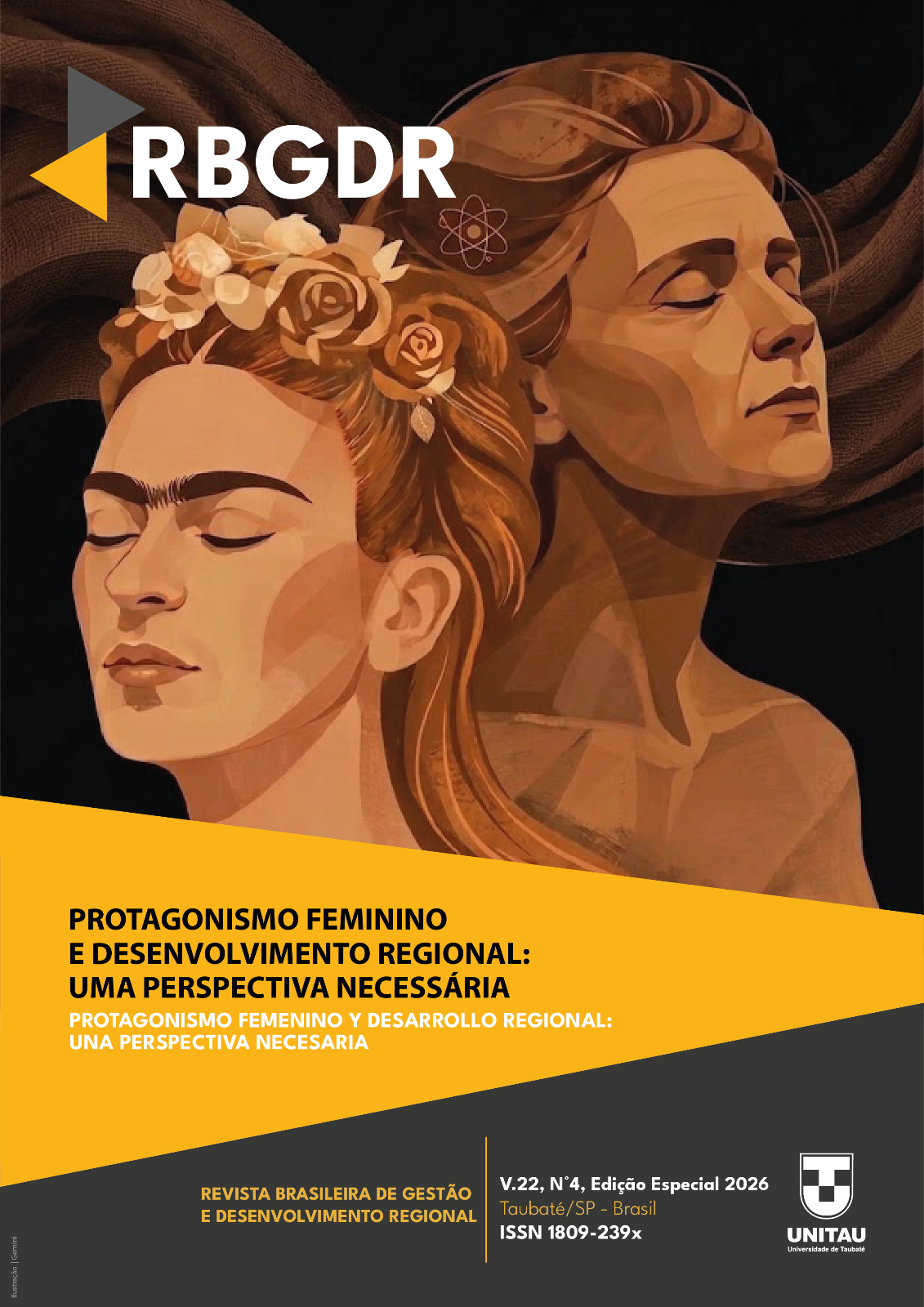
PROMOTION OF FEMALE LEADERSHIP IN PERNAMBUCO'S POLITICAL LANDSCAPE
DOI:
https://doi.org/10.54399/rbgdr.v22i4.8643Abstract
This article aims to analyze the female presence within the political landscape of Pernambuco, utilizing Indicator 5.5.1 of the 2030 Agenda (which measures the proportion of seats held by women in local parliaments and governments) and the Gender Parity Index (GPI). Specifically, it examines indicators of female participation in local governments and investigates the effectiveness of party quota policies. The methodology adopted was quantitative and descriptive, employing secondary data from the TSE, TRE-PE, and IPEA, and utilizing the Gender Parity Index calculation to evaluate parity in the 2024 municipal elections. The results demonstrate a low percentage of female victories, with women occupying only 16.30% of mayoral positions and 16.21% of city council seats in Pernambuco, classifying the GPI as "very poor." It was found that although the quota policy increased the number of candidacies (35.30% for city council), this progress did not result in proportional electoral success. The study concludes that Pernambuco has failed to meet Indicator 5.5.1 of SDG 5 regarding its political scenario, necessitating the improvement of quotas and oversight mechanisms to achieve a more inclusive democracy.
Downloads
Downloads
Published
How to Cite
Issue
Section
License
Copyright (c) 2026 Revista Brasileira de Gestão e Desenvolvimento Regional

This work is licensed under a Creative Commons Attribution-NonCommercial 4.0 International License.
Authors who have their papers accepted and published in the Brazilian Journal of Regional Management and Development must agree to the copyright policy CC BY https://creativecommons.org/licenses/by/4.0/.
If the article is accepted for publication, the copyright is automatically assigned to the Brazilian Journal of Regional Management and Development.
 English
 Español (España)
 Português (Brasil)